
 Volodymyr Lukaniuk
You can file a roof insurance claim in winter, and if you found storm damage this fall you should report it now rather than in April. Reporting the loss and getting the roof replaced are two separate things. The report and the evidence belong to this week. The tear-off can wait for a dry stretch in January, or for spring, as long as you keep the roof watertight in between and watch two deadlines that keep running while it snows.
It is a common question in November in the north and northwest Chicago suburbs. Someone notices a few shingles in the yard after the last fall windstorm, or a neighbor's roof goes up in October and they wonder about their own. Leaving it until the weather turns usually costs money, because the evidence and the deadlines do not wait for spring the way the roofing can.
What has to happen before the snow, and what can wait
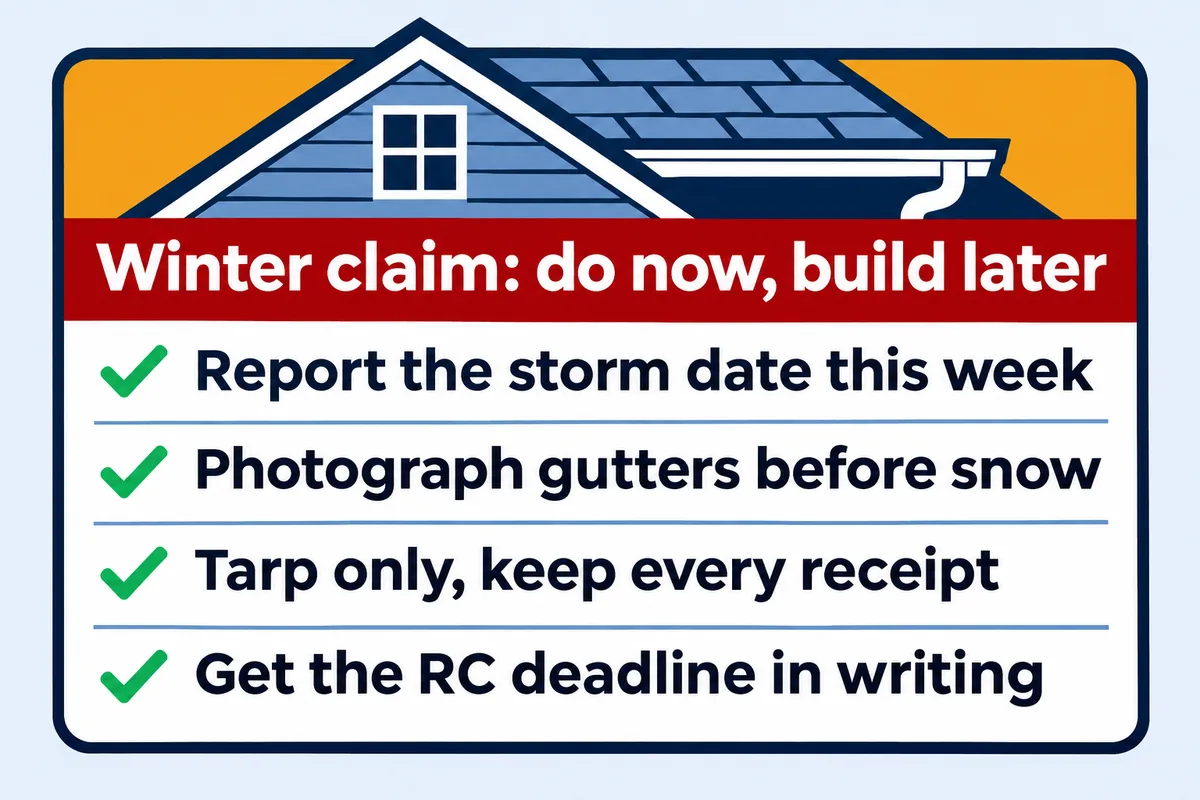
Split the claim into the parts that depend on what can be seen today and the parts that only depend on the weather. Everything that proves the damage and its date goes first. Everything that is construction goes on the calendar.
| Task | Do it this week | Can wait for a dry stretch |
|---|---|---|
| Telling the insurer | Report the loss and the storm date you believe caused it. Write down the claim number and the name of whoever took the call. | Nothing. A late report gives the carrier a reason to ask whether the winter made things worse. |
| Photos | Shingles on the ground, the roof from every side of the yard, dented gutters, downspouts, window wraps and siding, each with the date. | Close-up roof photos, which we take from the roof on a dry, snow-free day. |
| Stopping water | A tarp or a temporary patch where wind opened the roof. Keep the receipt. | The permanent repair. The Connecticut Insurance Department puts it plainly: make repairs to prevent further damage, but no permanent repairs until the insurer inspects. |
| Adjuster visit | Ask for the inspection now, and ask how the carrier handles a roof that is snow-covered on the day. | A second look at the shingles after a thaw, if the first visit only saw snow. |
| Replacement | Get the estimate and pick the shingle line, so the order can go in the day the weather opens. | The tear-off and the new roof. |
Why snow on the roof changes the adjuster's visit
Nobody can count hail hits or find creased shingles through four inches of snow. If the adjuster arrives on a white roof, the visit can turn into a look at the gutters and a promise to come back, or into a report that says no damage was observed. The second one is worse, because it sits in the claim file. If the day of your appointment comes with snow on the shingles, say so on the phone and ask for the roof part of the inspection to be moved to a clear day rather than done from the ground.
The good news is that a lot of storm evidence lives on parts of the house that snow does not cover, or covers only for a day. Soft metal and siding hold a dent for years, which is also how an adjuster tells a fresh storm from an old one (we explain that in our article on old hail damage and a new roof claim). Before the first real snowfall, photograph these up close with something for scale, a coin or a tape:
- Gutter faces and the tops of the gutter lips, where hail leaves round dents.
- Downspouts, especially the elbows at the bottom.
- Aluminum window wraps and the trim around garage doors.
- Vinyl siding on the side the storm came from, where hail cracks and punctures show.
- The fins of the air conditioner outside, which bend in neat rows when hail hits them.
- Any shingle pieces in the yard, before the snow buries them and the plow throws them away.
If a slope is facing south and clears quickly after a snowfall, we can often get on it in December and take the shingle photos the claim needs. A north slope may stay white until March. That is one more reason to start now: the clear days in a Chicago winter come at random, and you want your claim ready to use them.
One claim on the calendar: a worked example
Dates make the deadlines real. The example below is made up to show the arithmetic, and your own policy may count differently, so check its Loss Settlement and Suit Against Us conditions. It assumes a windstorm on October 20, 2026 that took shingles off a roof in Buffalo Grove or Palatine, and a policy that pays replacement cost.
- October 20, 2026. The storm
- This is the date of loss. Both deadlines below count from it.
- November 25, 2026. The owner reports it
- Five weeks later, after finding shingles by the fence. Still fine, but every extra week makes the carrier ask what happened in between.
- December 1, 2026. Proof of loss sent
- The signed form the policy asks for, with photos and an estimate. Under Illinois law this date pauses the suit clock, see the box below.
- January 8, 2027. First payment, one item refused
- The carrier pays the actual cash value of the roof (replacement cost minus depreciation) and turns down the gutters. Turning down part of a claim is a denial in part, and the paused suit clock starts running again from here.
- April 18, 2027. The replacement cost notice
- 180 days after the storm. The ISO sample homeowners form gives that long to tell the insurer you intend to collect the held-back depreciation once the roof is replaced. Many carriers print their own number. If the weather is still holding up the job, ask for more time in writing before this date, not after.
- November 27, 2028. Last day to sue over the gutters
- A two-year suit clause would have ended October 20, 2028. The 38 days between the proof of loss and the partial denial are added back.
"Whenever any policy or contract for insurance, except life, accident and health, fidelity and surety, and ocean marine policies, contains a provision limiting the period within which the insured may bring suit, the running of such period is tolled from the date proof of loss is filed, in whatever form is required by the policy, until the date the claim is denied in whole or in part."
215 ILCS 5/143.1, Illinois Insurance Code
Notice what the winter does in this example. The roof could not go on in December or February, and that is fine. The money that depends on the roof going on has a spring deadline, and the replacement has to be booked with that date in mind. People who wait until April to report a fall storm often find the 180 days nearly gone before the first check arrives. How the held-back money comes back is covered in our guide to recovering depreciation on an insurance claim, and what happens if the roof never gets replaced is in our article on keeping the insurance money.
Can the new roof go on in January?
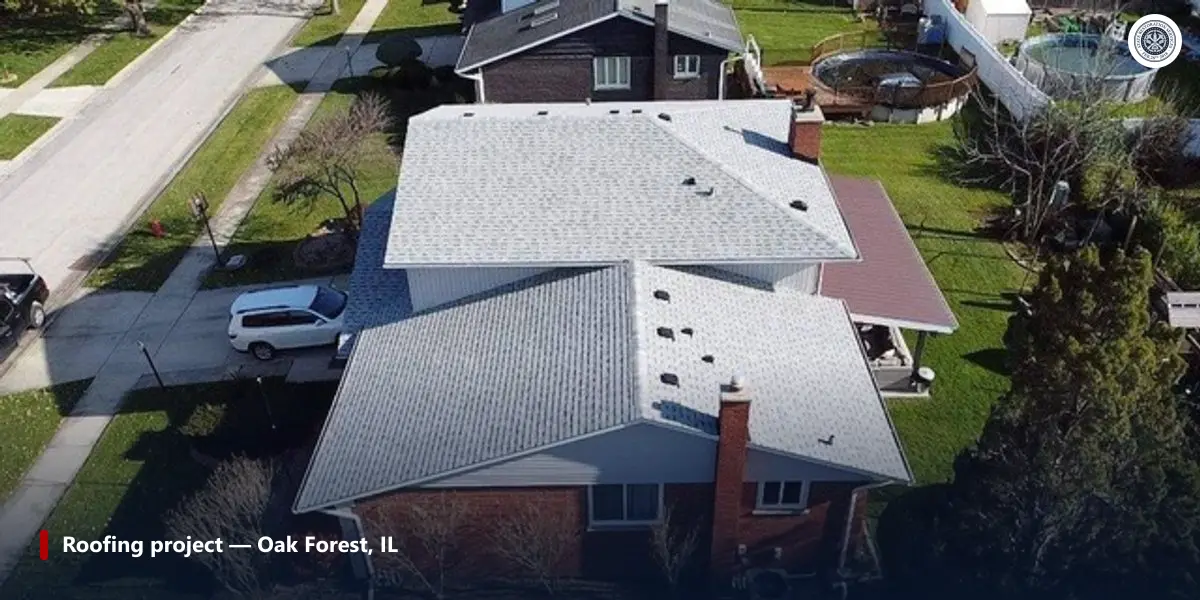
Often, yes, on the right days. A tear-off leaves the deck open for a few hours, so we need a dry forecast, a deck without ice on it, and temperatures where shingles can be handled without cracking. Those days come in most Chicago winters, just not on a schedule. Owens Corning, one of the three shingle makers we install, also treats a full winter reroof as doable once a run of good weather arrives. Its page on cold weather roofing projects adds one warning about the shingles themselves: in the cold the seal strips are slow to bond, and the crew may have to glue the tabs down by hand.
That warning matters for an insurance roof. A shingle that has not sealed yet can lift in the first spring wind, and a crew that skips hand sealing in the cold is setting up a second claim. We go through what the seal strip does and how we handle it in winter in our article on shingles that have not sealed on a new roof. If the roof is small, a single slope or a garage, the work fits into one clear day easily. A full two-story house may wait for a run of two or three. Either way, the order for materials and the dumpster can sit ready, so the job starts the morning the forecast opens. You can see how a full roof replacement runs from tear-off to cleanup on our service page.
Gutters are a different story. Seamless gutters are formed on site from a coil, and the hangers go into fascia that has to be dry and sound, so we usually book gutter replacement on a dry day after the roof is on, which also keeps new gutters out of the way of the tear-off.
Who does what on a winter claim
Illinois law does not let a roofing contractor negotiate an insurance claim, so our part is the physical one. We inspect the roof when it can be inspected, photograph and measure the damage, write a code-compliant estimate, answer the adjuster's technical questions about the construction, and build the roof when the weather allows. If you want someone to represent you on the claim itself, for example after a partial denial like the one in the example, our partner, the licensed Illinois public adjuster State Adjusting Services, does that work. More on how the two sides fit together is on our storm and insurance claim page.
One more winter note. Out-of-town crews that follow storms tend to leave town with the first frost, which is why a December roofing contract with a company nobody can find in March is worth a second look. We are based in Lincolnshire and work here all year.
Frequently asked questions
Will my insurer deny a claim because I waited until winter to report it?
A delay alone is not a reason in most policies, but the policy asks for prompt notice, and a late report lets the carrier argue that some of the damage came from the winter rather than the storm. Report as soon as you find the damage, and give the storm date you believe caused it.
Can the adjuster inspect my roof if it is covered in snow?
Not the shingles. Hail marks and creased shingles cannot be seen through snow. Ask for the roof part of the inspection to be done on a clear day, and photograph gutters, downspouts, siding and window wraps before the snow comes, since those keep storm marks for years.
Do I have to replace the roof before spring to get the full payment?
No, but watch the replacement cost deadline. The ISO sample homeowners form gives 180 days after the date of loss to tell the insurer you intend to claim the held-back depreciation, and many carriers print their own number. If the weather delays the job, ask in writing for more time before the date passes.
Found storm damage this fall? Book a free inspection or call (866) 992-2982. We work Monday to Friday 7:00 AM to 7:00 PM and Saturday and Sunday 9:00 AM to 5:00 PM across the north and northwest Chicago suburbs.