
Fiber cement siding installation, gap by gap and coat by coat
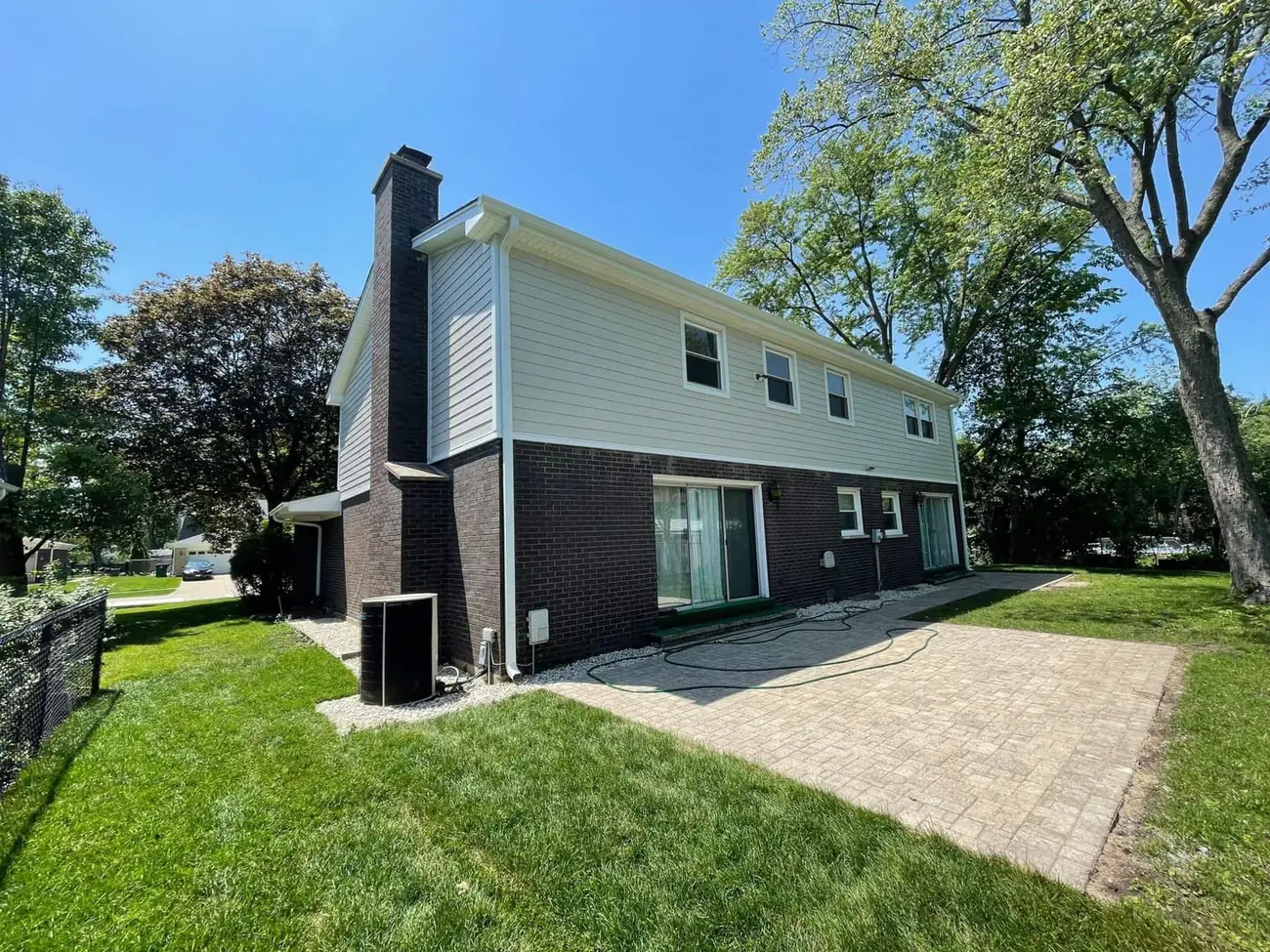
Fiber cement is a heavy board of cement, sand and wood fiber, nailed to the wall and then painted, or bought with the color baked on at the factory. It takes hail and wind better than vinyl and costs more: $8-$14 a square foot installed in the north and northwest suburbs.
Whether it lasts depends less on the board than on small gaps, how it was cut and when it got paint. This page shows those numbers so you can check them on your own wall. If you're still choosing a material, our vinyl or fiber cement comparison lays out the trade-off.
The gaps that keep fiber cement dry, drawn to scale
Fiber cement wicks water at a cut edge that sits in a puddle or against a roof. So James Hardie's installation sheet leaves an air gap wherever the board meets something wet. These are its numbers. Ask any installer, us included, to point them out on your house.
Above horizontal flashing
Over a window head, or where siding starts above brick. The gap stays open, never caulked.
1/4 inBeside gutter end caps
Where a gutter stops against a wall, so overflow can't sit on the siding.
1 inAbove the roofing
On every wall that rises from a lower roof, with step flashing under the shingles and a kickout flashing where that roof ends.
1-2 inAbove a deck
Measured from the deck boards, at the ledger where the deck meets the house.
1-2 inAbove paths, steps and driveways
Hard surfaces splash rain straight back at the bottom edge.
1-2 inLap of one plank over the next
The minimum overlap, whether the nails are hidden under the lap or driven through the face.
1 1/4 in
Source: James Hardie HardiePlank lap siding installation instructions. The gap above the lawn follows the local building code, and the ground itself should fall away from the wall, typically 6 in over the first 10 ft.
How the boards should be cut next to your house
Fiber cement contains crystalline silica, and cutting it with an ordinary saw throws fine dust that nobody should breathe. James Hardie ranks the ways to cut it, and federal rules set what a saw crew must use.
Best: score and snap, or shears
Almost no fine dust. The only methods James Hardie allows indoors.
Better: dust-reducing saw with a vacuum
A circular saw with a HardieBlade fiber cement blade, hooked to a HEPA vacuum.
Good: dust-reducing saw alone
For light cutting only, outdoors.
The OSHA row for this exact job
Table 1 of the federal silica rule, 29 CFR 1926.1153, covers handheld saws up to 8 in cutting fiber-cement board outdoors: a saw with a dust collection system, airflow at the tool maker's figure and a filter that is 99% efficient or better.
What you'd see at home: one cutting station in the driveway, set so the wind carries dust away from windows, and cleanup with a vacuum or water, never a dry broom.
Factory color or paint on site: the choice that sets your upkeep
Fiber cement is never left bare. You pick the finish before the first board goes up, and it decides how often the house needs a painter.
Color baked on at the factory
James Hardie sells boards finished in its own colors, like the Cobble Stone job above. A protective film comes off each course as soon as it's nailed.
Cut edges are sealed with the maker's edge coater or tucked into trim. Small nicks get its touch-up paint; a large scrape means a new board.
Primed board, painted on site
Any color you want. Primed board has to be painted within 180 days of going up, with a 100% acrylic topcoat. James Hardie says never to stain it.
The paint is what ages. Our siding guide puts a repaint at every 10-15 years, about $3,000-$6,000 for a house.
What fiber cement siding costs in the Chicago suburbs
It costs more than vinyl mostly because of labor. The boards are heavier, have to be cut with dust control and take longer to hang and finish. These ranges come from our own material comparison.
Fiber cement: $8-$14 a sq ft installed
Vinyl: $4-$9 a sq ft installed
On a typical two-story house in the suburbs, about 2,000-2,400 sq ft of wall, fiber cement comes to $18,000-$30,000 against $10,000-$18,000 for vinyl siding replacement. Trim, soffit and any storm repair are on top. You get a firm number after we measure the house, not over the phone.
Where fiber cement earns its price, and why many houses mix it
On most homes we quote, vinyl is the better value. Fiber cement is worth it in three cases, and it doesn't have to go on every wall.
- The house sits in an open spot that takes the full force of storms, where hail and wind would crack vinyl.
- You want the crisp shadow lines and wood-grain texture that fiber cement holds better than vinyl.
- You're staying 20 years or more. The board itself lasts 30-50 years; the paint is the part that needs care.
Can fiber cement and vinyl be used on the same house? Yes, and it's common: fiber cement on the street side or an accent gable, vinyl on the sides and back to hold the cost down. We tell you before the job where a change of material will show from the street. If the roof is due too, roof and siding in one project share the same flashing at every wall.
After hail or wind: a few boards or whole walls
Hail can crack fiber cement at the corners and chip the finish; wind can snap a board that lost a nail. A few broken boards on one wall are a siding repair, with new boards painted or ordered in the factory color to blend. Whole elevations battered by one storm can be an insurance claim. We photograph every wall, note the storm date and write a code-compliant estimate.
What Illinois law lets a contractor do
Illinois does not allow a roofing or siding contractor to negotiate an insurance claim. Our partner, the licensed Illinois public adjuster State Adjusting Services, can represent you with the insurer. The steps are on our storm and insurance page.
Who installs your siding
State Restoration Services is a family-owned roofing and exterior contractor in Lincolnshire, working since 2018 across the north and northwest suburbs, including Palatine, Northbrook and Buffalo Grove. Our own crews install vinyl, insulated, fiber cement and engineered wood siding.
Homeowners give us 4.9 from 91 Google reviews.
Office hours for siding questions
Phones are answered Monday to Friday, 7 AM-7 PM, and on weekends, 9 AM-5 PM.
Questions about fiber cement siding
- How much does fiber cement siding cost to install in the Chicago suburbs?
- About $8-$14 a square foot installed, of which $3-$6 is material and $5-$8 is labor. On a typical two-story house with 2,000-2,400 sq ft of wall that comes to roughly $18,000-$30,000, before trim, soffit or storm repair.
- Does fiber cement siding have to be painted?
- Yes. Either it comes with a factory color, or primed boards are painted on site within 180 days with a 100% acrylic topcoat. James Hardie says never to stain it. Plan a repaint every 10-15 years, about $3,000-$6,000 for a house.
- How long does fiber cement siding last?
- The board itself runs 30-50 years in our climate when the gaps and flashing are right. The finish is what needs attention, every 10-15 years for paint, so a well-kept wall looks new long after vinyl would have faded.
- Can fiber cement and vinyl be used on the same house?
- Yes, and it's common. Many owners put fiber cement on the street side or an accent gable, where the look matters most, and vinyl on the sides and back to hold the cost down. We point out any change of material that will show from the street.
Want this looked at?
We inspect for free, document what we find and prepare a code-compliant estimate you can hand to your insurer. Our partner, a licensed public adjuster, State Adjusting Services, can represent you on the claim.
Call (866) 992-2982. Free Inspection