
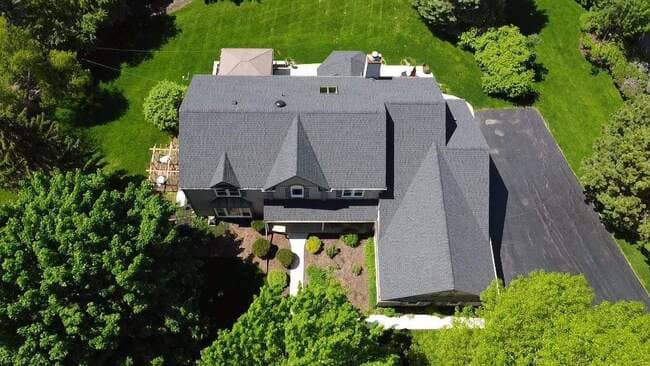
Roof valley repair: the channel where two slopes meet, rebuilt from the deck up
A valley takes the rain from two slopes at once, so it is often the first place an older roof starts to leak. We find which part of the valley lets water in, then rebuild that valley on the roof you keep: shingles off both sides, the deck checked, a new membrane, then metal or a clean closed cut.
Why one valley carries the water of a whole roof section
Rain runs straight down a slope until something stops it. Where a front gable meets the main roof, the rain from the main slope above it has nowhere to go but sideways into the valley, and it all leaves through a strip a few inches wide.
Each shaded area in the drawing is about 250 square feet of roof. A one-inch rain puts about 0.62 gallons on every square foot, so roughly 155 gallons go down each valley in that one rain.
The same funnel collects pine needles and maple seeds, and in winter it holds snow longer than the open slope, because the two slopes shade it. Our guide to open and closed-cut roof valleys explains why that ice sits there.
Which part of the valley is letting water in?
A valley leak rarely drips right under the spot where water gets in. It runs down the deck and the rafters first, which is why a valley stain on a ceiling often runs on a diagonal. Where the stain shows tells us which third of the valley to open first.
The top, where the valley meets a dormer, a wall or a chimney
The valley ends against something, and that joint is sealed with step flashing and often a bead of caulk. When the caulk dries out, water runs behind the metal. Our article on where a leaking dormer lets water in walks through the same joint from the inside.
The run, along the cut line and the center
A nail driven through the channel, a cut line that wanders onto the wrong side, or a valley built with no lining under it. On an older roof the shingles along the cut lose their granules first, because they carry the most water.
The bottom, at the eave and the gutter
Debris stops where the slope ends, and ice forms where the roof is coldest. Water held behind either one backs up under the shingles. Our ice dam prevention work covers the attic side of that winter leak.
What a valley rebuild includes, in the order we lay it
A valley that leaks along its run is rarely fixed by sealant on top. We take it apart and put it back in layers, on the roof you keep.
- 1
Shingles off both slopes, past the old lining
We remove the shingles on each side far enough to reach clean, dry deck and the edges of the old lining, and we photograph what we find before anything new goes on.
- 2
The deck under the valley checked by hand
A slow valley leak softens the plywood first. Rotted sheets are replaced at the price in our roof decking replacement guide, $75 to $120 a sheet, and only after you see them.
- 3
Ice and water shield down the full length
Section R905.2.8.2 of the International Residential Code accepts a self-adhering membrane as the valley lining. We run it from the eave to the top of the valley on every rebuild.
- 4
Metal or a closed cut, chosen for your valley
On laminated shingles GAF's own valley bulletin allows open or closed-cut valleys and rules out weaving them. We match what the rest of your roof has, unless the valley is long, shallow or under trees.
Open metal valleyPainted steel down the center, fastened only at its outer edges. Sheds ice and needles best, and costs more per foot.Closed-cut valleyOne slope's shingles run 12 inches past the center, the other side is cut in a straight line about 2 inches off it. - 5
Shingles tied back in, with the nail-free zone kept
New shingles are lined up with the old courses on both slopes, with no nail within about 6 inches of the center line. You get photos of the finished valley next to the ones from step 1.
How much does roof valley repair cost?
Rebuilding one failed valley on a roof that stays runs $400 to $1,200. Length, access and the deck under it move the number. If the valleys are built new as part of a full roof, they are priced by the foot, as below, using the ranges from our valley guide.
Ice and water shield in the valley is included in our reroofs. As a separate line it runs about $2 to $4 a foot. Rotted deck is added by the sheet once it is seen.
Repair one valley, or replace the roof around it?
A valley rebuild makes sense when the leak is in one valley and the shingles on both slopes still bend without cracking, because then the valley simply wore out ahead of the rest. For other leaks on the same roof, our roof repair crew can do the work in the same visit.
When the shingles beside the valley are curling and losing granules across the whole roof, a new valley only moves the next leak a few feet over. We will tell you so at the inspection, and the estimate for a full roof replacement then lists every valley by length and method.
Hail on the valley metal, and the insurance claim
Open valley metal is soft, so hail dents it the way it dents gutters and vents. Those dents help date a storm. Age, worn granules or a bad original cut are wear, and a carrier will not treat them as storm damage. For a hit roof, our page on hail damage roof replacement explains how we decide slope by slope.
What Illinois law lets a roofer do on a claim
Illinois law does not allow a roofing contractor to negotiate your insurance claim. We inspect the valleys, photograph and measure the damage and write a code-compliant estimate. Your carrier decides what it pays. Our partner, the licensed Illinois public adjuster State Adjusting Services, can represent you on the claim. Call (866) 992-2982 weekdays 7 AM to 7 PM, Saturday and Sunday 9 AM to 5 PM. Illinois roofing license 104.018671.
Questions about roof valley repair
How much does roof valley repair cost?
Rebuilding one failed valley on a roof you keep runs $400 to $1,200, depending on its length, how easy it is to reach and whether the deck under it has rotted. Rotted plywood is added at $75 to $120 a sheet once it is seen.
Can a leaking valley be sealed with roofing cement?
Cement can hold a cracked bead at the top of a valley for a season, but it does nothing for a missing lining, a nail through the channel or water backing up behind ice. Those leaks need the valley taken apart and rebuilt in layers.
Should my rebuilt valley be open metal or closed-cut?
Closed-cut suits short, steep valleys with no trees over them and matches most roofs around here. Open metal is worth its higher price per foot on long or shallow valleys and under oaks or pines that fill the valley every fall.
Is a hail-dented valley covered by insurance?
Dents in valley metal can be part of a hail claim when the storm also hit the shingles, gutters and vents, and your carrier decides what it covers. We document the damage and write the estimate, and our partner adjuster can represent you on the claim.
Want this looked at?
We inspect for free, document what we find and prepare a code-compliant estimate you can hand to your insurer. Our partner, a licensed public adjuster, State Adjusting Services, can represent you on the claim.
Call (866) 992-2982. Free Inspection