
 Volodymyr Lukaniuk
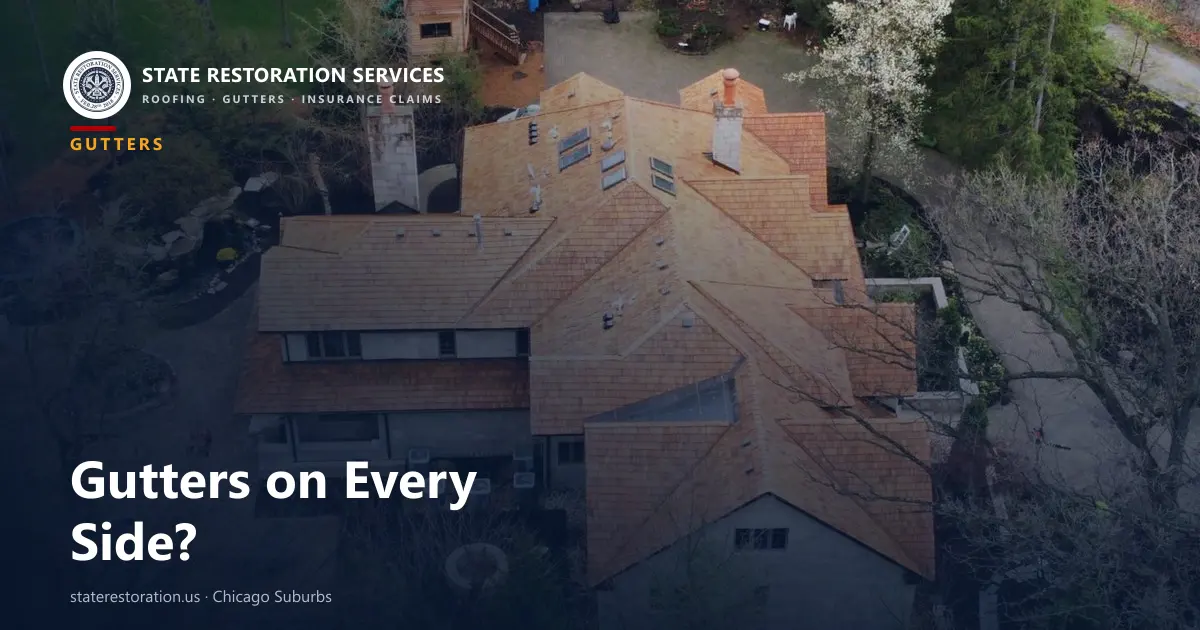
Do you need gutters on every side of the house? No. You need a gutter on every edge where a roof plane drains, and on many houses that is two sides, not four. On a plain gable roof, the kind shaped like a tent, the water runs down to the two long eaves, and the sloped ends (the rakes) shed almost nothing, so those walls can go without. On a hip roof, where all four sides slope down, every wall gets water and every wall needs a gutter. Most homes in the north and northwest Chicago suburbs are a mix of both, plus a valley or two, so the honest answer comes from walking the house edge by edge.
That walk is what we do before we write a gutter installation estimate, and you can do it yourself from the lawn in ten minutes.
Which walls get water, by roof shape
Stand at each corner and look at which way the roof surface above it slopes. Water follows the slope and leaves the roof at the low edge. If you are not sure what a hip or a rake is, our short explainers on the hip of a roof and the rake have pictures.
| Roof shape | Edges that drain | Gutters needed |
|---|---|---|
| Gable (two slopes, triangle walls at the ends) | The two long eaves | Two sides. The triangle ends get only wind-blown rain. |
| Hip (four slopes, no triangle walls) | All four eaves | All the way around. |
| L-shaped or T-shaped gable | Every long eave, plus the inside corner where a valley ends | The eaves, and the inside corner is the one you can least afford to skip. |
| Shed or lean-to (one slope) | The single low edge | One side. |
| Dormer or upper roof above a lower roof | Its eave, onto the roof below | A short gutter, or a downspout carried onto the lower roof's gutter, so one stripe of shingles does not take the whole flow. |
The same house with a gable roof and with a hip roof
The table makes more sense with numbers. One inch of rain on one square foot of roof is 144 cubic inches of water, which is 0.623 gallons. What matters is the roof's footprint seen from above, not its pitch, because a steeper roof does not catch more rain from the sky.
Take a 30 by 40 foot house with a one-foot overhang all around. From above, the roof covers 32 by 42 feet, or 1,344 square feet, so a one-inch rain puts about 838 gallons on it either way. The shape decides where that water lands.
Gable, ridge along the 42-foot length
Two planes, each 42 x 16 = 672 sq ft.
Each long side: 419 gallons.
Each end wall: next to nothing.
Hip, same footprint, equal slopes
Ends are triangles: 32 x 16 / 2 = 256 sq ft each.
Long sides: (1,344 - 512) / 2 = 416 sq ft each.
Each long side: 259 gallons. Each end wall: 160 gallons.
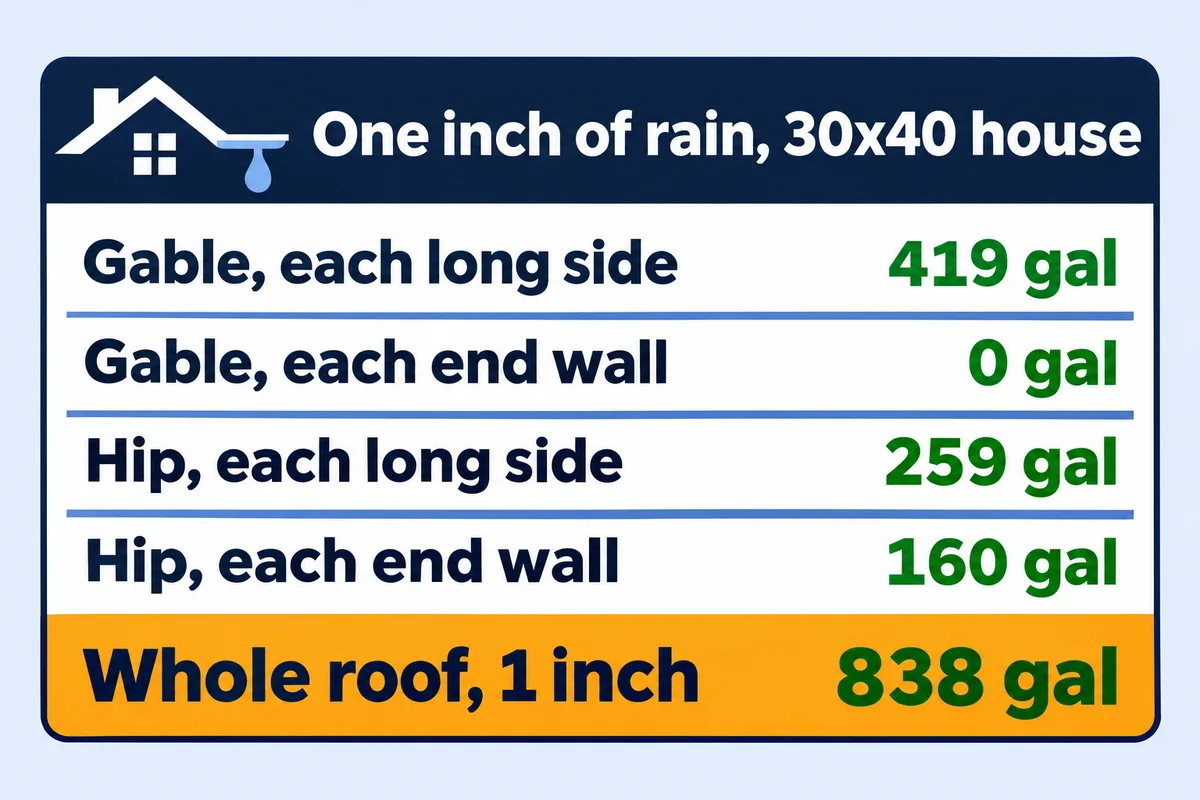
So on the hip version, skipping the two short ends means 320 gallons per inch of rain falling straight off the eaves onto the ground beside the foundation. On a house with a basement, that is the water that shows up as a damp corner in the spring.
The gable version tells the opposite story. A gutter across a rake end catches almost nothing, because no roof surface slopes toward it. The money for those two runs would have done more as a bigger downspout on the long side; our article on why gutters overflow in heavy rain explains why the downspout, not the gutter, is usually the bottleneck.
Edges people skip and later regret
The eave over the front or back door
Even on a gable house, a short run of eave often sits right over a stoop or a deck stairs. In winter that drip line becomes an ice patch on the exact spot everybody walks. A gutter there is a few feet long and solves it.
The inside corner below a valley
A valley collects water from two roof planes and drops it at one point. When there is no gutter at the bottom of a valley, the stream digs a trench in the mulch and sends water against the foundation at one corner. If you only put a gutter on one edge of the house, put it there.
An upper roof that drains onto a lower roof
A second-story eave or a dormer that empties onto a porch or garage roof wears a stripe into the shingles below, and in January the water freezes along that stripe. A short gutter with its downspout carried down to the lower gutter spreads the flow.
When a draining eave can go without a gutter
Sometimes an eave that does drain can still be left bare. We would only say so when every one of these holds for that wall:
- The wall has no basement or crawl space behind it, for example a detached garage or a shed.
- The ground slopes away from the wall and stays sloped after a few years of settling.
- Nobody walks under that drip line, so winter ice there is harmless.
- The overhang keeps the falling water off the siding and the window sills.
Miss one of those and the gutter is cheaper than the fix. Where the water goes after the downspout matters as much as the gutter itself, and that is covered in our guide to where downspouts should drain.
Frequently asked questions
How many downspouts does a two-sided gutter system need?
At least one per run, and on most houses one at each end of a long run. The size of the roof plane draining into the run decides it, so a long side of a big gable roof usually needs two.
Is it worth putting gutters on the gable ends to make the house look finished?
Only if you like the look. They carry almost no water, so they protect nothing, and they add more feet of gutter to clean and keep pitched.
Can I add gutters to just one side now and the rest later?
Yes. Gutters are sold and installed by the foot, and a new run can be added to the next side later. Start with the side that has a door, a valley or a basement wall behind it.
Want us to walk your roof edges and mark which ones drain? Book a free inspection and we will tell you which runs your house needs, and which ones it does not.