
Ridge cap repair: cracked, lifted or missing caps fixed along the top of your roof
The caps along the ridge and down the hips are the highest, most exposed shingles on your house. When a few of them crack, lift or blow off, we replace those caps with pre-bent caps matched to your shingle color and check the vent underneath, so the rest of the roof keeps working.
A drawing made for this page, not a customer's roof. The key below tells you what each number means.
Which of the five faults is on your ridge?
Stand across the street, or look at a phone photo zoomed in on the top of the roof. Most ridge trouble falls into one of these five, and each has its own fix.
A split across the fold where the cap bends over the ridge. Cold makes a stiff or cut-up cap snap there.
We replace the cracked caps and the ones touching them.
A gap in the row, often after a windy night, with the ridge vent or bare deck showing.
We fit new caps over the gap and check the vent for water.
The tail flaps or sits up because its sealant strip let go. The next storm usually takes it.
Hand-sealed if it lies flat again, replaced if it's creased.
Rusty heads or nails backing out on the exposed part of a cap. Each one is a hole into the roof.
We pull them and reset the cap with hidden nails.
Dark spots where granules were knocked off. Caps stand up from the roof, so hail hits them hardest.
We photograph every hit for a possible claim.
Why the top of the roof fails before the slopes
Caps sit highest and stick up
Every cap rises above the slope, so hail strikes it square on and wind gets under its edge first. Our wind damage repair page shows ridge and hip caps lifting along their length before the field shingles move.
Each cap is bent over a sharp fold
A real cap is made to bend. A field shingle cut into pieces and folded over the ridge isn't, and on an architectural roof it tends to crack in cold weather.
The nails are close to the vent
Caps are nailed on both sides of the vent slot. A loose or rusted nail there lets water fall straight into the attic, with no deck below to slow it.
Replace a few caps or re-cap the whole ridge?
Most calls end as a repair of a short stretch. These are the conditions we check before we write either one into your estimate.
A few caps
the usual outcome- The damage is in one or two spots, after one storm.
- The other caps still bend without cracking and lie flat.
- Matching caps in your shingle color can still be bought.
- The vent underneath is sound and the deck at the ridge is dry.
The whole ridge and hips
when a patch won't hold- The caps are cut-up field shingles, and they're cracking in several places.
- Caps are lifting along most of the ridge, not just one stretch.
- The vent under them is torn, crushed or the wrong type for your attic.
- The whole roof is near the end of its life, and a patch would be wasted money.
When the slopes themselves are worn out, ridge work alone won't fix the leaks. Our roof repair page explains how we decide between a repair and a new roof.
The vent under the caps gets checked too
On most roofs we work on, the caps cover a continuous ridge vent. When a cap blows off, rain and snow can drive straight through that vent. So we lift the caps next to the damage, look at the vent and the deck edge, and tell you what we see.
A cracked or crushed section is replaced with the caps. Adding a ridge vent where there was none is a separate job, quoted on its own, and only worth it with enough soffit intake to feed it. Our attic ventilation repair page covers that check.
How our crew finishes a ridge
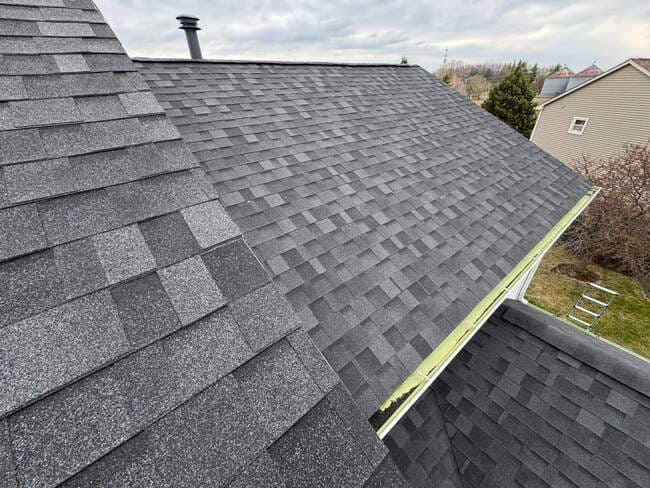
- The damaged caps come off, and so do the ones overlapping them, so the new caps sit under a sound cap above.
- New caps are the maker's pre-bent hip and ridge caps in the color of your roof, not field shingles cut down.
- Every nail goes where the next cap covers it. Nothing is left exposed on top.
- Lifted caps that still lie flat are sealed down by hand with roofing sealant.
- Before any of it starts, the inspection photos show you which caps are damaged, and the written estimate says what will be replaced.
Hips get the same treatment as the ridge. If you're curious about the parts themselves, our guide on what hip and ridge are on a roof explains them.
Hail marks on the caps and your insurance
Because caps stand up from the roof, they usually show the clearest hail bruising of anything up there. Insurance estimates price hip and ridge as their own line, and a missing or underpriced hip-and-ridge line is a gap we often find when we document a roof. When the slopes are hit as hard as the caps, the job is bigger than a ridge repair; our page on hail damage roof replacement shows how that's decided slope by slope.
What Illinois law lets a roofer do
A roofer in Illinois may not negotiate an insurance claim for you. We photograph and measure the damage and write a code-compliant estimate. Our partner, the licensed Illinois public adjuster State Adjusting Services, can represent you on the claim. The storm and insurance page explains how that works.
Who comes up on your roof
Our own crews, from our office at 1 Overlook Point in Lincolnshire. We're a family business licensed in Illinois as a roofer under number 104.018671, working across the north and northwest suburbs.
from 91 Google reviews
When to call us
Monday to Friday from 7 AM until 7 PM. Saturday and Sunday from 9 AM until 5 PM. Water coming in at the ridge? Tell us when you call, and we'll prioritize getting out to tarp it.
Questions about ridge cap repair
Can you replace just a few ridge caps?
Yes. When the damage is in one or two spots and the other caps still bend and lie flat, we replace only the damaged caps and the ones overlapping them. That's how most ridge calls end.
Can a lifted ridge cap be sealed back down?
Often it can. If the cap lies flat again and isn't creased or cracked, we seal it down by hand with roofing sealant. A creased or torn cap is replaced, because it will lift again in the next strong wind.
Will new ridge caps match my roof?
We use the maker's own hip and ridge caps in your shingle color when they're still sold. New caps look a shade cleaner than weathered ones at first. If your color is gone, we show you the closest options before any work starts.
Does a missing ridge cap cause a leak?
It can, quickly. Under most ridge caps is a vent slot cut through the deck, so rain and blowing snow can drop straight into the attic. If a cap is gone, look for wet insulation or stains near the top of the ceiling and call us.
Want this looked at?
We inspect for free, document what we find and prepare a code-compliant estimate you can hand to your insurer. Our partner, a licensed public adjuster, State Adjusting Services, can represent you on the claim.
Call (866) 992-2982. Free Inspection